A calm, practical guide to PFAS, local water quality and why more Brisbane families are looking at complete home filtration to improve confidence in the water used across the whole home.
This page is designed to help homeowners separate headlines from practical decisions and understand when a premium whole-home system makes sense beyond a single tap filter.
Why this topic matters
PFAS stands for per- and polyfluoroalkyl substances a group of persistent synthetic chemicals that have become a major public water-quality talking point in Australia. They are often called “forever chemicals” because they can persist in the environment for a long time. That persistence is exactly why the topic gets attention and why national guidance has tightened.
For Brisbane and South East Queensland homeowners, the key point is this: PFAS is a valid issue to understand, but it should not push you into fear-based decisions. Good filtration decisions come from understanding your local water, your actual household pain points, and the difference between a single drinking-water fix and properly designed complete home filtration.
The local context
According to Seqwater, South East Queensland drinking water is safe to drink and meets the updated Australian Drinking Water Guidelines for PFAS. That matters, because good advice should begin with the public facts, not with manufactured urgency.
At the same time, many families do not look into filtration only because water is officially “unsafe”. They do it because they want to improve the overall quality of the water coming into the home every day especially the water used for showering, washing, drinking, cooking and protecting fixtures and appliances over time.
SEQ water remains within current national PFAS guideline values, and the local supply is actively monitored.
Pool-like shower smell, dry skin and hair, sediment after storms, rust, scale and wanting more confidence in the water used throughout the property.
What changed
Public concern increased after updated national guidance in 2025 and renewed media attention in 2026, including Australian research that looked at fertility and embryo effects in mice exposed to trace PFAS via drinking water. That research matters because it adds to the body of concern around long-term exposure. It does not mean a premium filtration company should start making sweeping health claims about ordinary tap water.
For Jila Water, the better position is the more credible one: explain the issue clearly, acknowledge the official guidance, and help homeowners decide whether reducing exposure and improving day-to-day water quality across the whole home is worth doing for their household.
Visual guide
Before looking at specific system types, it helps to step back and understand the broader picture. PFAS is part of the conversation, but so are chlorine or chloramines, sediment, shower comfort, scale and the difference between treating one tap and treating the whole home.
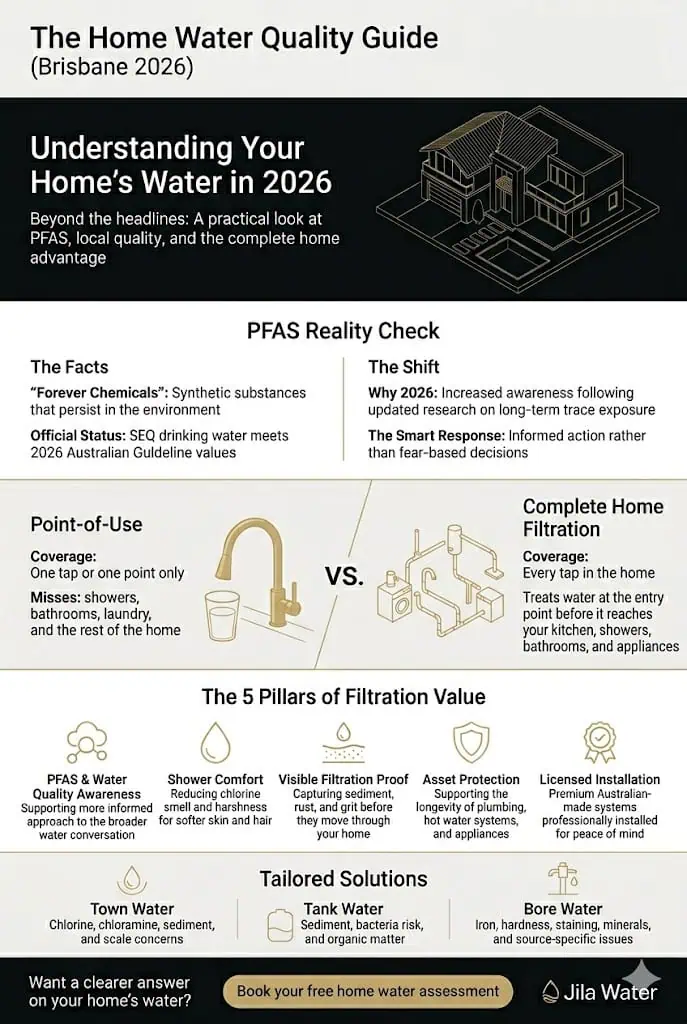
For many homes, the real decision is not about chasing one headline. It is about choosing a complete home filtration strategy that improves confidence, comfort and everyday water quality across the property.
The real buying decision
Most Australians begin by looking at a smaller point-of-use filter. That makes sense as a first step, but it only treats water at one outlet. A complete home filtration system treats the water where it enters the property, which means the benefits flow across the kitchen, showers, bathrooms, laundry and the rest of the home.
That difference matters because many of the most frustrating water complaints in Brisbane do not show up only at the kitchen sink. They show up in the shower, around tapware, on glass, in the laundry, and in the way the whole home feels day to day.
To make the bigger picture easier to understand, here is a simple guide to how PFAS concerns, local water quality, and complete home filtration fit together for Brisbane homeowners.
For many homes, the real decision is not just about one contaminant. It is about choosing a practical whole-home approach that improves water quality, comfort and confidence at every tap.
| Feature | Jug or under-sink filter | Complete home filtration |
|---|---|---|
| Drinking water improvement | Yes, but only at one outlet. | Yes, while also improving the rest of the home water experience. |
| Shower water | No meaningful whole-home impact. | Yes — the system treats water before it reaches showers and bathrooms. |
| Every tap coverage | No. | Yes — kitchen, bathrooms, laundry and the rest of the home. |
| Chlorine smell support | Only where the small filter is fitted. | Broad property-wide benefit when the system is properly specified. |
| Plumbing and appliance support | No. | Yes — a whole-home approach supports fixtures, wet areas and connected appliances. |
| Best fit | Small, single-point improvement. | Homeowners wanting a premium all-home result rather than a partial fix. |
What to say honestly
This is where straight answers matter. Not every home filtration setup is designed specifically for PFAS reduction, and not every cartridge media performs the same way. Performance depends on the exact chemistry involved, the media used, the contact time, the system design and the conditions of the water itself.
That is why premium advice should never overclaim. The smarter homeowner question is usually broader: what do I want this system to improve across my whole home? For many Brisbane households, the answer includes chlorine or chloramines, sediment, rust, scale support, better shower comfort and cleaner water across every tap.
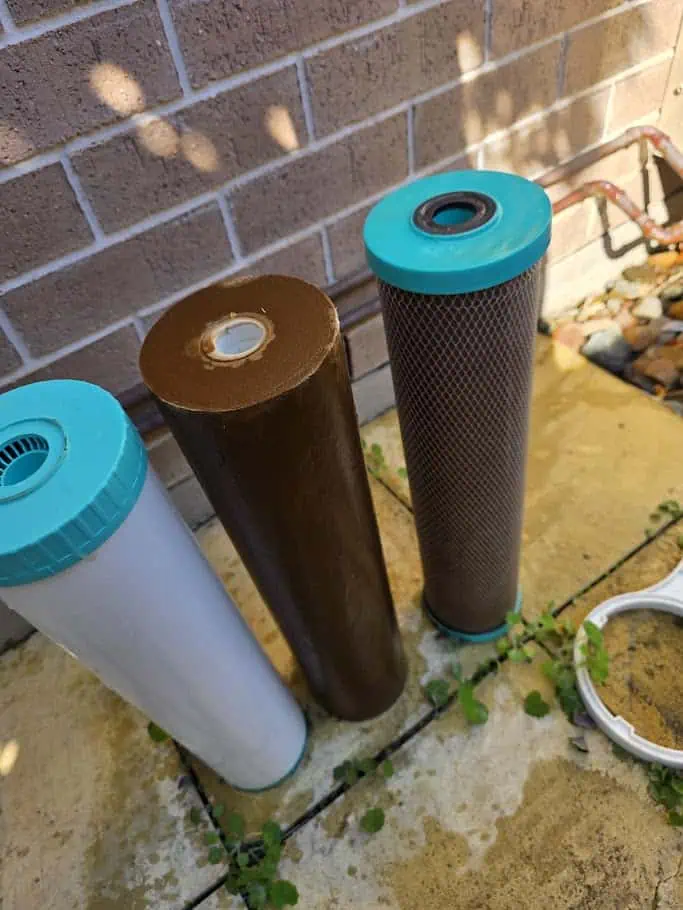
One of the strongest ownership benefits of complete home filtration is that homeowners can often see what is being trapped over time. Dirty sediment filters make the value easier to understand because the proof is not theoretical it is sitting in the spent cartridge instead of continuing through the home.
That is one reason premium whole-home systems often feel more tangible than a generic specification sheet alone.
Why homeowners still move forward
Not just drinking water. Showers, bathrooms, laundry and the rest of the home all benefit when the system is placed at the entry point.
Many families first notice the difference in chlorine smell, general harshness, and the way their skin and hair feel after showering.
Sediment, rust and scale can affect more than comfort. They can also affect the long-term cleanliness and wear of wet areas and appliances.
A whole-home system is a major upgrade. It should look considered on the wall and be installed properly by licensed plumbers.
Homeowners investing in their property usually want a solution that feels intentional, serviceable and built to last.
The value is not only in what a system removes. It is also in the peace of mind that comes from understanding your water and treating it properly.
Different homes, different water
Most metro households are focused on chlorine or chloramines, sediment, rust, scale and improving the feel of the water used every day throughout the home.
Tank systems often need a different priority list, including sediment, organic matter, bacteria risk and seasonal variability from roof runoff and storage conditions.
Bore water can present more complex chemistry, including minerals, metals, hardness, smell, staining and source-specific treatment needs.
The best system is not simply the cheapest one online. It is the system matched to your water source, flow demand, household size and what you actually want to improve.
Buying guide
Frequently asked questions
No. The better response is to stay informed, understand the official guidance, and make practical decisions about the water quality you want throughout your home.
Current Australian guidance has said PFAS exposure through showering and bathing is considered negligible. For most homeowners, the stronger shower-related reason to filter is chlorine-related smell and general shower comfort.
No. A jug or under-sink filter improves one point of use. Complete home filtration treats water at the point it enters the home so the benefits extend across the whole property.
No. Town water, tank water and bore water often require different treatment priorities. Household size and flow demand matter too.
For many homeowners, it is confidence: better water at every tap, a more comfortable shower experience, visible proof through used filters, and a professionally installed system matched to the home.
Free home water assessment
If you want straightforward guidance on your water source, household size and whether complete home filtration is the right fit, book a free home water assessment with Jila Water. No pressure. No generic script. Just a better path to filtered water at every tap.
Suggested internal links