Water Testing Brisbane: Identify Contaminants In Your Home Water
Brisbane & SEQ water quality guide

Water testing • contaminants • filtration advice

The importance of water testing and identifying contaminants in your home’s water.

Water can look clear and still carry taste, odour, sediment, hardness, metals or source-specific issues. A proper water assessment helps you understand what is happening before choosing the right filtration system for your home.

Local water contextBuilt around Brisbane, Ipswich, Logan, Redlands, Moreton Bay, Gold Coast and SEQ homes.
Every tap approachTesting helps decide whether a point-of-entry solution is a smarter fit than one filtered tap.
Licensed installationJila systems are installed by licensed plumbers and tailored to the home’s water source.
Practical next stepBook a free home water assessment before spending money on the wrong filter.

Quick answer: water testing matters because different water problems need different solutions. Chlorine taste, earthy odours, sediment, staining, hardness, metallic taste, bacteria risk in tanks, bore minerals and emerging contaminants are not all treated the same way. Testing and inspection help identify what is likely present, what needs proper lab confirmation, and which filtration setup is appropriate for the home.

Why test first?

Clear water does not always mean clean-feeling water.

In South East Queensland, most town water is professionally treated and monitored before it reaches the network. But homeowners may still notice chlorine taste, sediment after rain or mains work, scale on fixtures, metallic taste from plumbing, or different issues from tank and bore water.

That is why the best filtration conversation starts with your water source and your actual symptoms. A family on Brisbane mains water usually needs a different approach from a home on tank water, bore water or a mixed supply.

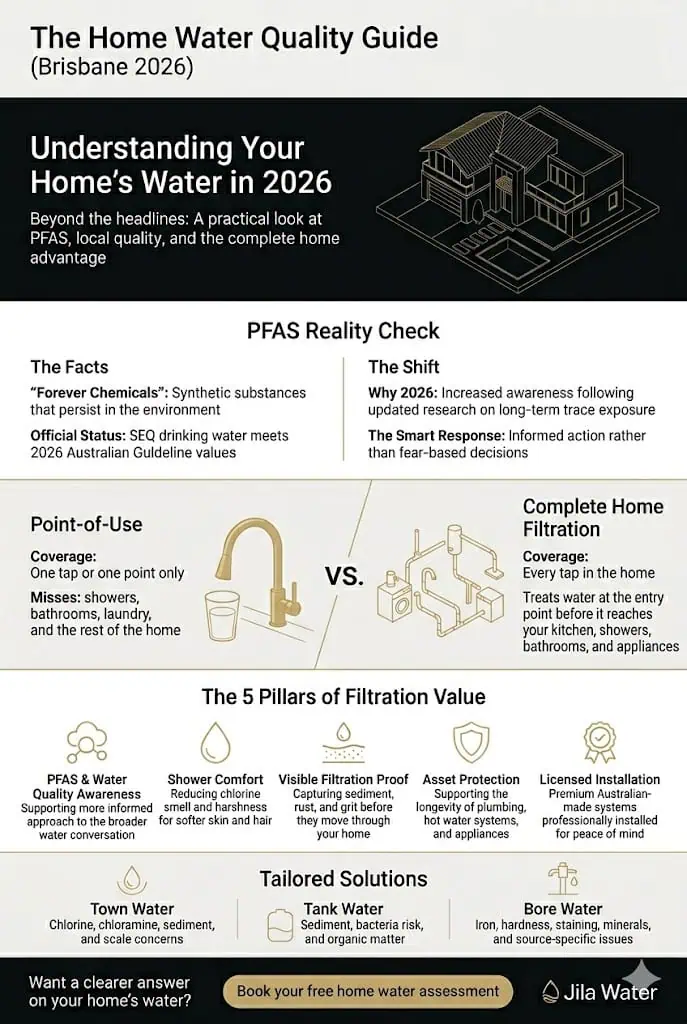
Jila Water home water quality guide infographic for Brisbane homes explaining water quality, PFAS awareness and complete home filtration
Use water testing and water quality context to understand what your home actually needs before choosing a filter.
Common water issues

What a home water assessment may investigate.

Every home is different. These are the common water quality clues Jila Water looks at when helping Brisbane and SEQ homeowners understand their water.

Sediment & cloudiness

Fine particles, pipe disturbance, tank debris or post-rain events can affect the look and feel of water. Sediment filtration is often the first protection stage in a whole home system.

Chlorine or chemical taste

Disinfection is part of keeping town water safe through the network, but many households dislike the taste, odour and shower feel of chlorinated water.

Hardness, scale & minerals

Minerals can contribute to scale, marks on glass, appliance buildup and a harsher feel. Conditioning media may be recommended depending on the home’s water profile.

Metallic taste or staining

Iron, manganese, copper or older plumbing can affect taste, colour and staining. The right next step depends on whether the issue is supply, household plumbing, tank or bore related.

Testing by water source

Town water, tank water and bore water need different questions.

A “one size fits all” filter recommendation is where many homeowners waste money. The water source should guide the testing and filtration plan.

Water source Common things to check Why it matters Typical Jila Water direction
Town / mains water Chlorine or chloramine taste, sediment, hardness, pH, scale, metallic taste, local supply changes and household plumbing. The water may meet drinking water standards but still feel, smell or taste unpleasant at home. Whole home sediment, conditioning and carbon filtration tailored to the household and local water profile.
Rainwater tanks Sediment, roof debris, tannins, odour, microbial indicators, pH and UV suitability. Tank water quality changes with roof condition, gutters, first flush devices, animals, heat and rain events. Sediment filtration, carbon filtration and often UV sterilisation where microbial protection is needed.
Bore water Iron, manganese, hardness, staining, salinity, pH, minerals and source-specific contaminants. Bore water can vary dramatically even between nearby properties and usually needs source-specific testing. Custom filtration design after reviewing bore results and household use requirements.
Mixed supply Separate testing for each source and how the home switches or blends water. A filter that suits one water source may not suit the other. Tailored system design based on the plumbing layout and water source priority.
The goal is not to sell the biggest filter. The goal is to understand the water first, then design the right system for the home.

Important safety note

A free home assessment is not the same as a certified laboratory health test. If you suspect contamination, illness, bacteria, chemicals, a water advisory issue, or a private supply risk, contact your water provider, local council, Queensland Health or a NATA-accredited laboratory for formal testing advice. Jila Water can help you understand symptoms and filtration options, but health-critical contamination should be properly confirmed.

How the process works

A better way to choose a water filter.

Instead of guessing from a product list, Jila Water works backwards from your home, your water source and your symptoms.

Start with the home and water source

We look at whether the home is on mains, tank, bore or mixed supply, then consider the number of bathrooms, household size, flow needs and where the system can be installed.

Document the symptoms

We ask what you notice: chlorine smell, earthy taste, metallic taste, staining, scale, dry skin and hair, sediment, cloudy water, tank odour or bore water marks.

Check whether lab testing is needed

For tank, bore, suspected bacterial or health-critical concerns, proper laboratory testing may be recommended before a final system is selected.

Match the filtration stages

Only after the water picture is clearer do we recommend the right combination of sediment filtration, conditioning media, carbon filtration, UV, or a custom design.

Contaminants & indicators

What can water testing identify?

The right test depends on the water source and the concern. Some checks are simple field indicators, while others require laboratory analysis.

Aesthetic indicators

Taste, smell, colour, sediment, cloudiness, hardness, staining and scale are often the first reasons homeowners book an assessment. They affect daily comfort and confidence even when the water is not necessarily unsafe.

Chemical indicators

Depending on the supply, testing may look at pH, chlorine residual, metals, minerals, PFAS-related concerns, salinity, hardness or source-specific chemicals.

Microbial indicators

For tanks, bores and private supplies, microbial testing is often the most important question. E. coli and other indicators require correct sampling and laboratory handling.

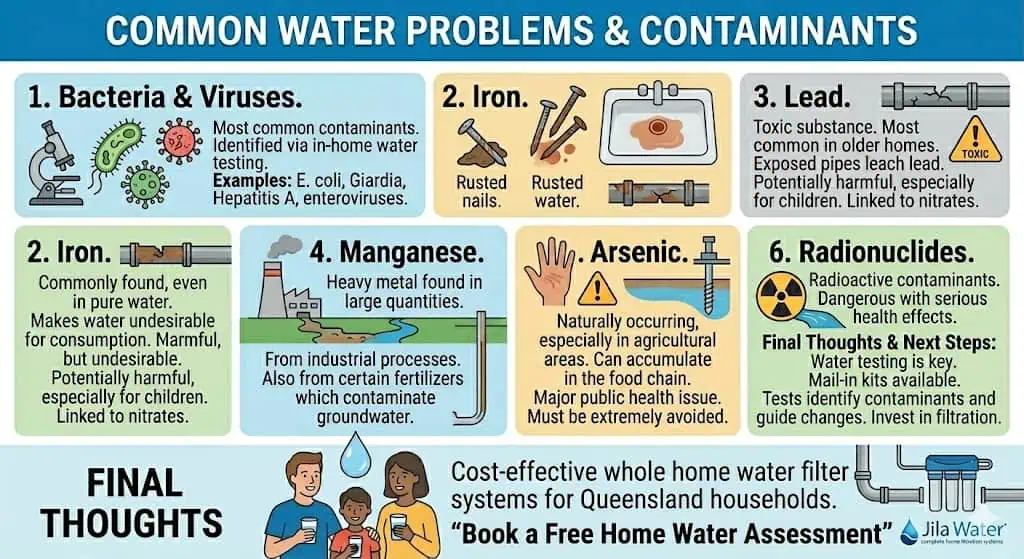
Infographic showing common water problems and contaminants including bacteria, iron, lead, manganese, arsenic and radionuclides in Queensland homes
Common water problems can include sediment, iron, manganese, metallic taste, chlorine odour and, for tank, bore or private water supplies, health-related contaminants that should be confirmed through proper laboratory testing. Use this as a practical guide, not as a substitute for certified testing advice.
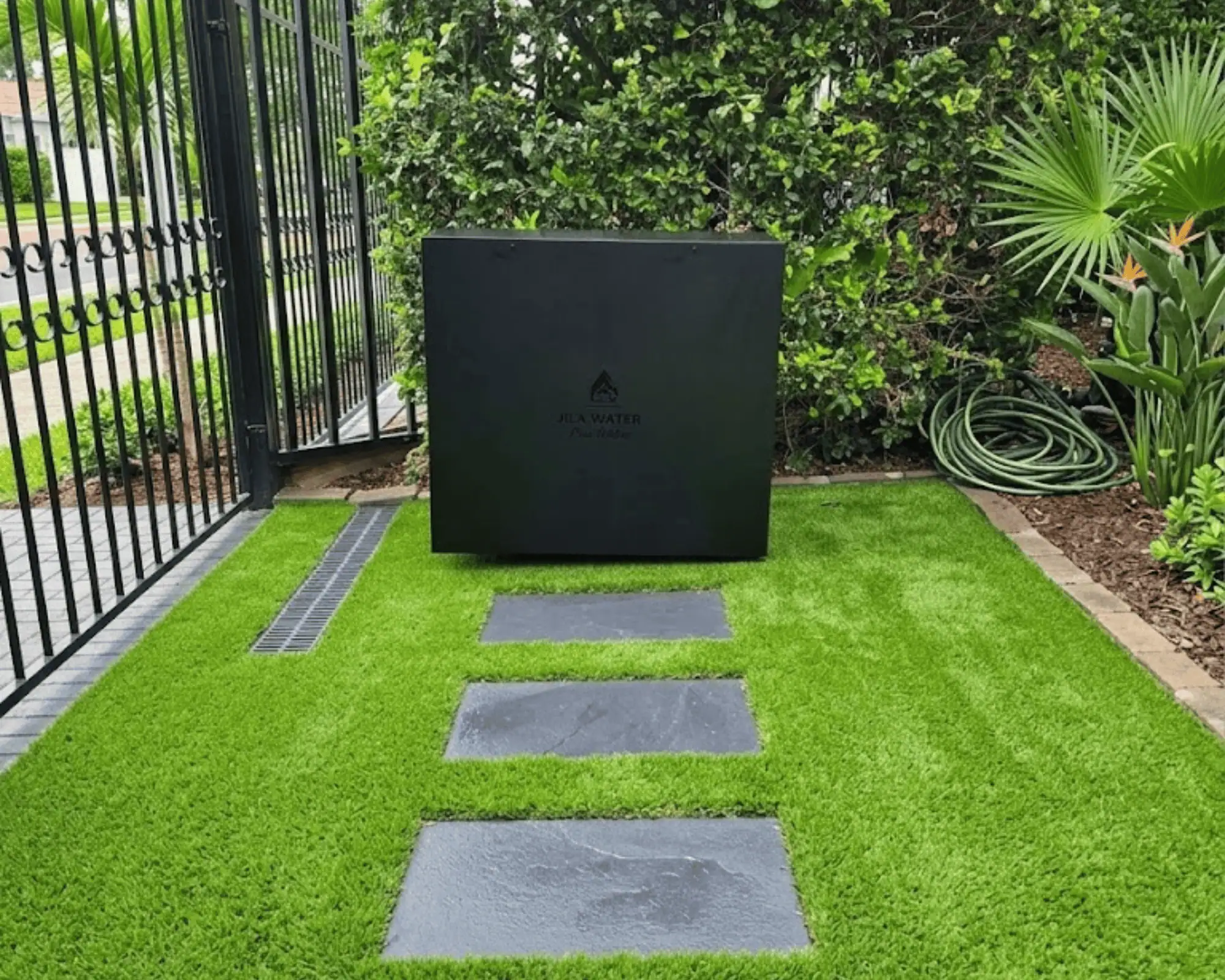
Premium Jila Water whole home filtration system installed outside a Brisbane home
A complete home filtration system treats the water as it enters the home, before it reaches showers, bathrooms, laundry, kitchen taps and appliances.
From testing to action

Why testing often points to complete home filtration.

If the problem affects more than one tap, a single under-sink filter may not solve the whole-home issue. A point-of-entry system treats the incoming supply before it moves through the home.

This is why Jila Water focuses on complete home filtration for many Brisbane and SEQ families. The aim is cleaner, better-feeling water at every tap — not just one drinking water outlet.

FAQs

Water testing questions Brisbane homeowners ask.

Do I need to test Brisbane town water?

Not every home needs a full laboratory test. Brisbane and SEQ town water is monitored by the relevant water providers, but a home assessment can still be useful if you notice chlorine taste, sediment, scale, odour, metallic taste or issues that seem specific to your property.

Is a home water assessment the same as a laboratory test?

No. A home water assessment helps identify likely issues, water source, symptoms and filtration needs. Health-critical concerns such as bacteria, chemicals, illness, private supply risk or contamination should be confirmed through an appropriate accredited laboratory or water authority process.

What should tank water be tested for?

Tank water may need checks for sediment, colour, odour, pH, microbial indicators such as E. coli, roof or gutter contamination, and whether UV treatment is appropriate. The right test depends on how the tank is used and whether the water is used for drinking.

What causes metallic taste in tap water?

Metallic taste may come from trace metals, corrosion, internal plumbing, older fixtures or source-specific minerals. If it appears suddenly or affects only one tap, the cause may be different from a whole-house issue.

Can filtration remove every contaminant?

No single filter removes every possible contaminant. The right system depends on what is in the water, the water source, flow requirements and the household’s priorities. That is why testing and assessment should come before system selection.

When should I contact my water provider?

Contact your water provider if you are on town water and there is sudden discolouration, strong odour, suspected contamination, a local advisory, illness concern, burst main issue or a change affecting multiple properties. For private supplies, the owner is generally responsible for managing water quality.

Free home water assessment

Want a clearer answer on your home’s water?

Book a free Jila Water home water assessment. We’ll look at your water source, what you’re noticing, your home layout and the best filtration pathway for your family.

Author & local expertise

Written for Jila Water by James Grady

James works with Brisbane and SEQ homeowners to understand local water concerns and choose complete home filtration systems that suit the home, water source and household priorities.

View Author Profile
Book Free Water Assessment

Jila Water Knowledge Hub

Complete Home Filtration, Hard Water, and How a Water Softener Works

Hard water does more than leave marks on taps. It can affect shower comfort, create scale across the home, and leave homeowners guessing about what is really going on in their water. This guide breaks down how a water softener works, how to start testing your water properly, and why complete home filtration is often the smarter whole-home solution.

Whole Home Filtration Water Testing & Hard Water Brisbane & SEQ Homes

No pressure. No guesswork. Just clearer advice on what suits your home, your water, and the result you actually want.

Complete home filtration guide

Complete Home Filtration, Hard Water Testing, and How a Water Softener Works

If your shower screen always looks marked, your hot water system keeps copping scale, or your skin feels dry after every shower, there is a good chance hard water is part of the story. This guide breaks down how to start testing my water, what testing for hard water should actually involve, how a water softener works, and why complete home filtration is often the smarter long-term move for Australian homes.

Premium whole-home focus Built for Australian homes Assessment-first approach
Every tap matters
Whole-home thinking goes beyond the kitchen sink. It looks at showers, bathrooms, laundry, plumbing, appliances and the overall daily water experience.
Best next step

Start with a proper home water assessment. A real recommendation comes from understanding the property, the household, and the actual water issues rather than guessing from a single number or a random pen meter.

What is hard water?

Hard water is water with elevated levels of dissolved minerals, mainly calcium and magnesium. In the home, that usually shows up as scale buildup, cloudy glassware, residue on taps and shower screens, and water that feels less pleasant to live with day to day.

The problem is not just appearance. Hard water can slowly affect fixtures, hot water systems, pipes and appliances over time. That is why more homeowners are starting to look beyond a single tap filter and toward a more complete solution.

Typical homeowner symptoms
What you notice What it often points to
White marks on shower glass and taps Scale and mineral residue building up from regular water use
Cloudy glasses from the dishwasher Mineral spotting and poor rinse performance
Dry skin or dull hair after showering Water quality issues affecting daily shower comfort
Kettle or heating element scaling up fast Hardness stressing hot water fixtures and appliances
Soap that struggles to lather properly Higher mineral load interfering with washing performance

Signs your home may have hard water

Most homeowners do not begin their search with the phrase “ion exchange resin”. They start with frustration. They are sick of cleaning the same shower glass, replacing fixtures too early, or feeling like the water never quite feels right.

Bathroom signs

White crusty deposits on taps, stubborn shower screen spotting, and residue around bathrooms are often some of the first visible clues.

Appliance signs

Scale on kettle elements, reduced efficiency in hot water systems, and ongoing mineral buildup can all point to hardness issues through the home.

Daily living signs

Skin that feels tight after showering, hair that feels dull, and laundry that feels stiff are common reasons families begin testing their water.

Jila Water approach

Most homes do not need more guesswork. They need the right test and the right system design.

That is why the strongest path is usually to start with a free home water assessment, then match the home to the right complete home filtration setup based on real use, real symptoms and the result the family actually wants.

Testing my water: how to start checking for hard water properly

If you have ever typed testing my water into Google, you are not alone. The issue is that a lot of people get a number from the wrong tool and assume they now understand their water. That is where confusion starts.

The strongest approach is to treat testing for hard water as its own step. You are not just looking for a random reading. You are trying to find out whether hardness is really present, how serious it is, and whether the home needs a water softener, broader filtration, or both.

1. The simple soap test

Fill a clean bottle with tap water, add a few drops of pure liquid soap and shake. Soft water usually produces stronger, longer-lasting bubbles. Hard water tends to produce less lather and more cloudy residue. It is basic, but it can be a helpful first clue.

2. Hardness test strips

One of the easiest at-home ways of testing for hard water is to use hardness strips. They are a quick screening tool and can help identify whether you are likely dealing with a low, moderate or high hardness issue.

3. Drop-count hardness kits

If the number matters, a proper hardness-specific test kit is a better move. This is stronger than relying on a generic conductivity or TDS pen and gives you a more useful picture when you are choosing treatment.

4. Professional home assessment

The most valuable option is an in-home assessment that looks at symptoms, source water, household demand and the most suitable treatment approach. This is where a premium system recommendation becomes far more accurate.

Important: if you are checking the performance of a new system, test from a cold softened line rather than a mixed shower outlet. The closer the sample point is to the actual treated line, the more useful the result will be.

How a water softener works

A water softener is designed to reduce the minerals that cause hardness, mainly calcium and magnesium. The most common method is ion exchange.

Inside the softener is a resin bed charged with sodium ions. As hard water passes through the resin, the calcium and magnesium in the water swap places with the sodium. The result is water that is much less scale-forming as it moves through the home.

Step 1

Hard water enters the system carrying calcium and magnesium that contribute to scale.

Step 2

The resin media captures the hardness minerals and exchanges them for sodium ions.

Step 3

Softer water leaves the system and moves through showers, taps, appliances and the rest of the home with reduced scale potential.

That is the simple version of how a water softener works: it removes the minerals responsible for hard-water behaviour, helping reduce scale and improve the overall water experience throughout the property.

Why a water softener alone is not always enough

A softener can be excellent at dealing with hardness, but hardness is not the only issue homeowners care about. Many homes also want help with sediment, chlorine taste and odour, shower comfort, and cleaner water at every tap. That is where complete home filtration becomes the stronger long-term story.

Complete home filtration is about more than one symptom. It is about protecting the home more broadly and improving the way the water is experienced throughout the day.

Basic water softener

Focuses mainly on hardness and scale-related mineral issues.

  • Good for calcium and magnesium reduction
  • Helps reduce scale on fixtures and appliances
  • Does not automatically solve every whole-home water concern

Complete home filtration

Takes a broader whole-home approach to how water is used and experienced.

  • Can address sediment before it reaches the home
  • Can include hardness treatment where needed
  • Can improve chlorine taste and odour issues
  • Supports a better water experience in bathrooms, showers, kitchen and laundry

If you want to see how Jila positions this kind of upgrade, explore the main complete home water filtration system page or browse more education on the Jila Water blog.

The big mistake people make: TDS is not the same as hardness

This is one of the most useful trust-building points you can put in front of a homeowner.

Someone says, “I tested my water and got 324.” The immediate question should be: 324 of what?

If that number came from a generic TDS pen, it does not automatically tell you how much calcium is present and it does not prove whether a water softener is working properly. A softener can reduce hardness while TDS still looks similar because the chemistry of the water has changed rather than all dissolved solids simply disappearing.

Put simply: a TDS number is not a hardness diagnosis. If you want to know whether you have hard water, use a proper hardness-specific method or book a professional assessment.

Who benefits most from complete home filtration?

Homeowners usually get the most value from complete home filtration when they are trying to fix more than one issue at once.

Families dealing with scale

If taps, glassware, bathrooms and hot water systems are constantly showing mineral buildup, a system that includes hardness treatment can make a major difference.

Homes wanting better shower water

Many households are less worried about drinking water alone and more interested in what they shower in every day. That is where whole-home thinking becomes more valuable.

Homeowners wanting a premium upgrade

The strongest systems do not feel like a cheap afterthought strapped to the wall. They feel like a considered home improvement with proper support and professional installation.

Ready for better water?

Find out what is actually happening in your water before you buy anything.

Book a free home water assessment, get clarity on the problems you are trying to solve, and let Jila Water recommend the right complete home filtration path for your home.

No obligation. No pressure. Just a clearer path to better water at every tap.

Frequently asked questions

What is hard water?

Hard water is water containing elevated levels of dissolved minerals, mainly calcium and magnesium. In the home, it often shows up as scale buildup, residue on fixtures, cloudy glassware and a rougher day-to-day water feel.

How does a water softener work?

A water softener usually works through ion exchange. Calcium and magnesium swap places with sodium on a resin bed, reducing the scale-forming minerals moving through the home.

How do I start testing my water for hard water?

You can start with a simple soap test, hardness strips, or a hardness-specific drop-count kit. For a more reliable recommendation, a professional in-home water assessment is the strongest move.

Does a TDS pen tell me if I have hard water?

Not properly. TDS and hardness are not the same thing. A TDS reading can be useful for general water discussion, but it is not the right standalone test for diagnosing hard water.

Is a water softener the same as complete home filtration?

No. A water softener focuses on hardness. Complete home filtration is broader and can include sediment filtration, hardness treatment and improved taste and odour control across the home.

What is the best next step if I think my home has hard water?

Start by booking a free home water assessment. You can also learn more about Jila Water on the About page or browse additional guides in the blog.

Take The Next Step